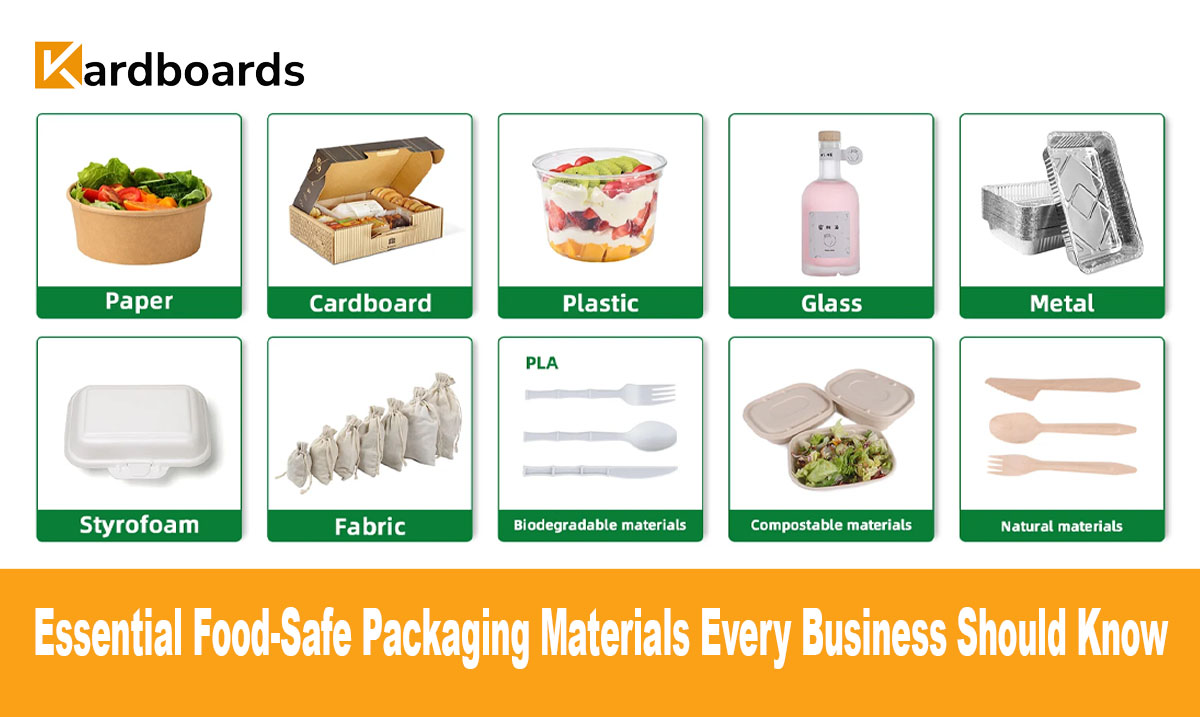
Choosing the right food-safe packaging material is critical for product safety, shelf life, regulatory compliance and consumer trust. This guide breaks down the most commonly used food-grade materials, where they work best, and important regulatory and sustainability trade-offs to consider.
Food-Safety & Regulatory Overview
Food packaging must meet local and export market regulations. Key points to verify with any supplier:
- Food contact approvals: Materials should be certified for food contact (e.g., EU food contact regulation, FDA 21 CFR in the US, GB standards in China).
- Migratory testing: Ensure no harmful substances migrate into food (heavy metals, plasticizers, monomers).
- Traceability & documentation: Supplier declarations, certificates of analysis, and full material specifications for audits and customs.
Common Food-Safe Packaging Materials
Paperboard & Coated Paper
Widely used for dry foods, bakery, cereals and outer cartons. When combined with appropriate coatings or liners, paperboard can be suitable for moist or fatty foods.
- Advantages: Renewable, printable, recyclable (when mono-material).
- Limitations: Needs barrier coating or lining for high-moisture or oily products.
Polyethylene (PE)
Used for films, pouches, and freezer packaging. Good moisture barrier and flexibility.
- Advantages: Excellent moisture resistance, heat-sealability, low cost.
- Limitations: Recycling varies by film type; not a strong oxygen barrier.
Polypropylene (PP)
Stiffer than PE — used for tubs, microwaveable containers and thermoformed trays.
- Advantages: Good heat resistance, chemical resistance, recyclable in many streams.
- Limitations: Moderate oxygen barrier; may need multilayering for long shelf life.
Polyethylene Terephthalate (PET)
Common for clear trays, bottles and clamshells. Excellent clarity and good barrier properties when amorphous PET (APET) is used.
- Advantages: High clarity for retail display, good strength, widely recycled (rPET options available).
- Limitations: Oxygen barrier is fair; not ideal alone for very long shelf life of oxygen-sensitive foods.
EVOH (Ethylene Vinyl Alcohol) & Barrier Layers
EVOH is used as a thin barrier layer in multilayer films to prevent oxygen ingress — vital for cooked meats, cheese and sensitive products.
- Advantages: Outstanding oxygen barrier in thin layers.
- Limitations: Must be protected from moisture and typically requires lamination to other polymers or adhesives.
Aluminum Foil & Laminates
Aluminum provides near-perfect barrier against light, oxygen and moisture — used in pouches, retort packaging and lidding films.
- Advantages: Excellent barrier, used for long shelf-life applications and retort processing.
- Limitations: Heavier, can complicate recycling unless separated or designed into mono-material solutions.
Bioplastics (PLA, PHA) & Compostables
Plant-based films and containers (like PLA) are increasingly used for salads, fresh produce and takeaway food where compostability is desired.
- Advantages: Lower fossil-carbon footprint when industrially composted; consumer appeal.
- Limitations: Performance (heat, barrier) and home-compostability vary — certification (EN 13432, ASTM D6400) is essential.
Molded Pulp & Paper Alternatives
Excellent for trays, egg cartons, hot-food carriers and protective inserts where biodegradability is prioritized.
- Advantages: Compostable, renewable, good cushioning.
- Limitations: Limited moisture resistance unless lined; design constraints for thin features.
Adhesives, Inks & Coatings
Food-grade adhesives and inks are crucial — water-based, soy-based or FDA-approved systems are common.
- Ensure: All adhesives and inks are food-contact approved when contacting food, or separated by a suitable barrier.
Selecting the Right Material: Practical Guidelines
- Match barrier needs to product: Moisture, oxygen, light and grease each require different protection strategies.
- Consider processing: Retort, freezing, microwave and pasteurisation impose specific material requirements (e.g., heat resistance).
- Check end-of-life and recyclability: Mono-material designs and clear disposal instructions reduce contamination in recycling streams.
- Test in real-world conditions: Shelf-life studies, migration tests, and transportation simulations will reveal real performance.
Quick rule: If your product is oxygen-sensitive use EVOH or aluminum barrier; if moisture is the main concern prioritize PE/PP layers; for visibility and retail appeal consider PET/rPET.
Testing, Certification & Supplier Documentation
Before mass production, require your supplier to provide:
- Food contact certificates and declarations.
- Migration and extractables test reports.
- Performance tests: seal strength, retort stability, freezer/thaw cycles.
- Traceability: batch records for raw materials and additives.
Sustainability Trade-offs & Practical Tips
Sustainable choices often involve trade-offs between performance and recyclability.
- Prefer mono-material where possible: Easier to recycle (e.g., PP tubs vs. PP laminated with EVOH).
- Use recycled content: rPET and recycled board reduce embodied carbon but verify food-grade compliance.
- Design for disassembly: If laminates are necessary, make them easy to separate or clearly label disposal steps for consumers.
Frequently Asked Questions
What is the safest material for direct food contact?
Materials certified for food contact (with supporting migration tests) such as PE, PP, PET, and food-grade coatings are commonly used. The “safest” option depends on application, temperature and food type.
Can recycled plastics be used for food packaging?
Yes — but only if they are processed and certified for food contact (e.g., food-grade rPET). Always request supplier certifications and migration testing.
Are compostable packaging materials suitable for all food types?
Not always. Compostable films and coatings can be suitable for many fresh foods and takeaways, but heat/retort or long shelf life applications may require traditional barriers.
How do I verify my supplier’s food-safety claims?
Ask for certificates of analysis, food contact declarations, migration reports, and audit records. Independent lab testing and factory audits increase confidence.
Does multilayer packaging make recycling impossible?
Multilayer films are more challenging to recycle in standard streams — but some specialist recycling or chemical recycling solutions exist. Prioritise mono-material designs where possible to simplify recycling.