Packaging choice is often the first physical interaction your customer has with your product. Rigid gift boxes project luxury and durability, while folding cartons are versatile, cost-effective, and sustainable at scale. Understanding the trade-offs lets you align packaging with product value, margin, and logistics.
What is a Rigid Gift Box?
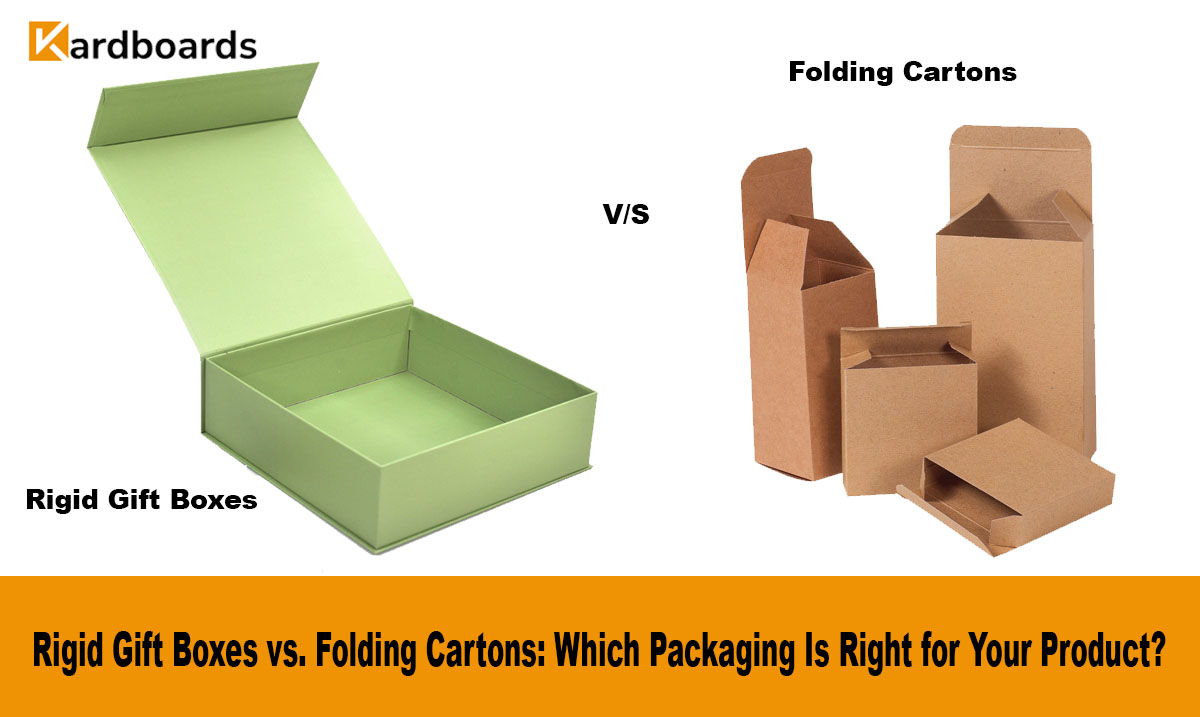
Rigid gift boxes (also called rigid set-up boxes) are made from thick chipboard or greyboard wrapped with printed paper, laminated stock, or specialty coverings. They are manufactured as a set-up box and lid or as a one-piece magnetic or hinged construction. They’re widely used in premium categories — jewellery, high-end cosmetics, watches, and electronics accessories.
- Construction: Thick multi-ply chipboard (commonly 1.5–3.0 mm total thickness per panel) with wrap-around cover materials.
- Finishes: Soft-touch lamination, gloss/UV spot, hot foil, embossing, satin ribbons, magnetic closures.
- Perceived value: High — tactile weight and structure communicate premium quality.
Quick fact: Rigid boxes typically cost 3–8× more per unit than standard folding cartons, depending on size and finishes.
What is a Folding Carton?
Folding cartons are die-cut sheets of paperboard scored and folded into shape. They ship flat and are assembled at the point of fill. They are the workhorse of product packaging—lightweight, inexpensive, and highly printable.
- Construction: Single- or multi-ply paperboard (commonly 200–650 gsm) with folding glue or tuck closures.
- Finishes: Full-bleed printing, aqueous or UV coatings, varnish, spot UV; windowing with PET/PLA if required.
- Perceived value: Moderate — excellent for branding but less premium tactile impression than rigid boxes.
Side-by-side Comparison
| Attribute | Rigid Gift Boxes | Folding Cartons |
|---|---|---|
| Cost per unit (approx.) | High — premium materials & assembly | Low — efficient die-cut and flat shipping |
| Perceived premium | Very high | Moderate |
| Production speed | Slower — manual finishes and set-up | Faster — high-speed die-cut and print lines |
| Logistics | Bulky — ships assembled unless nested | Space-efficient — ships flat |
| Customization options | Extensive — specialty closures, inserts, foils | High — printing options & die-cut windows |
| Sustainability | Depends — often mixed materials (laminates, foils) | Generally better — recyclable single-material boards |
| Protection | Excellent — rigid structure protects fragile items | Good — needs inner supports for fragile SKUs |
When to Choose Rigid Gift Boxes
Rigid boxes are the right choice when the packaging itself must be a part of the product experience and justify a premium price point.
- Luxury positioning: High-ticket items where unboxing is part of perceived value (jewellery, premium electronics, fragrance).
- Repeat usage: Products meant to be kept and reused (keepsake boxes, gift sets).
- Protection needs: Delicate items requiring structural support.
- Brand storytelling: When tactile finishes (soft touch, foils, emboss) are essential to convey brand identity.
When to Choose Folding Cartons
Folding cartons are ideal when cost, speed, and sustainability are primary concerns without sacrificing print quality and shelf presence.
- High-volume consumer goods: FMCG, cosmetics, pharmaceuticals where unit costs matter.
- E-commerce and retail balance: Lightweight cartons reduce shipping cost and carbon footprint.
- Fast seasonal runs: Quick turnaround promotional packaging or limited editions.
- Recyclability: Single-material paperboard options that fit recycling streams.
Cost & Supply Chain Considerations
Unit economics and supply chain logistics are frequently the deciding factors:
- Order quantity: Rigid boxes have higher set-up and tooling cost; they become economical at mid-to-high volumes but require larger upfront CAPEX for tooling and manual labor for assembly.
- Packing & shipping: Folding cartons ship flat — significant freight savings. Rigid boxes ship nested or assembled (bulk) and take more volume.
- Lead times: Folding cartons often have shorter lead times; rigid boxes may add time for laminating, foiling, and assembly.
- Tooling & samples: Expect longer prototyping cycles for rigid set-up boxes due to cover materials and special finishes.
Sustainability & End-of-Life
Sustainability depends on materials and finish choices more than the box style alone.
- Folding cartons: Easier to design for recyclability — single-material boards, water-based inks, and minimal laminates.
- Rigid boxes: Can be sustainable when made with recycled chipboard and paper wraps — avoid mixed plastic windows, metallized films, or heavy laminates to keep recyclability high.
- Biodegradable alternatives: Use PLA windows, water-based coatings, and biodegradable foams for inserts to improve lifecycle impact.
Design & Branding Tips for Each Format
Rigid Gift Box Design Tips
- Use subtle finishes (soft-touch, blind emboss) for a refined look rather than over-saturating with foil and gloss.
- Consider custom die-cut foam or molded pulp inserts for premium product presentation and protection.
- Think about reusability — magnetic closures and sturdy lids increase perceived longevity.
Folding Carton Design Tips
- Maximize print area for storytelling — structural simplicity lets printing do the work.
- Use strategically placed windows or inserts to showcase the product without sacrificing recyclability.
- Minimize heavy laminates; choose aqueous varnish or PLA coatings where required.
Practical Decision Matrix
Answer these quickly to decide which packaging fits your product:
- Is the product premium and price-insensitive? → Rigid
- Is unit cost a major constraint? → Folding Carton
- Does the product require long-term protection or reuse? → Rigid
- Do you require fast turnaround and low freight? → Folding Carton
- Is recyclability the top priority? → Folding Carton (unless rigid uses single-material covers and no lamination)
Rule of thumb: If packaging adds more perceived value than it costs and helps justify the retail price, rigid is worth it. If margins, speed, and sustainability matter most, folding cartons usually win.
Manufacturing in China — What to Expect
China offers both rigid box set-up factories and ultra-efficient folding carton plants. When sourcing:
- Ask for material certificates: GSM, board composition, FSC certification.
- Inspect finishes: Request print color proofs, foiling samples, and assembled prototypes.
- Check packaging logistics: Confirm whether suppliers deliver nested rigid boxes or assembled units and calculate freight/warehouse costs accordingly.
- Compliance: Ensure RoHS/REACH and export documentation are provided, especially for cosmetics or electronics packaging.
Real-world Examples
- Premium watch brand: Uses rigid box with foam insert and magnetic closure — enhances unboxing and offers post-purchase storage.
- Mass-market skincare: Uses folding cartons with high-quality graphics and a small inner insert — balances perception with supply chain efficiency.
- Subscription gift set: Uses a hybrid approach — folding carton for outer shipper, rigid tray inside for presentation.
Frequently Asked Questions
Are rigid boxes recyclable?
Rigid boxes can be recyclable if created from single-material chipboard wrapped in paper. Avoid mixed laminates, plastic windows, or metallized films to keep them recycling-friendly.
Which option is better for e-commerce?
Folding cartons often perform better for pure e-commerce due to lower shipping weight and ability to ship flat. Rigid boxes can be used when the customer experience justifies higher shipping cost.
How do costs compare at different volumes?
At low volumes (under a few thousand units), rigid boxes usually remain more expensive per unit due to labor and materials. Folding cartons scale more efficiently; per-unit costs drop significantly with higher print runs.
Can I mix both for the same SKU?
Yes. A common approach is to use a folding carton for bulk shipping and place a smaller rigid tray or sleeve inside for the retail presentation — combining benefits of both formats.
How long does prototyping take?
Folding carton proofs can be ready in days for print-ready dielines. Rigid box prototyping (with coverings, inserts, and foils) takes longer — typically 7–21 days depending on finishes and sample iterations.